


The Count of Buena Vista Winery – Theatre
Narrator) Here ye, Here ye!
About to begin is an epic play… an entertainment that shall reveal the History
of Wine in the Sonoma Valley and THE COUNT OF BUENA VISTA. This is the story of
Count Agoston Haraszthy; the Hungarian Nobleman who came to America and founded
Buena Vista Winery. The Count was born in Hungary in 1812… as a young man he
was engaged in the family business; growing wheat in the Bacska region of
Hungary. He also grew grapes… and made wine in Tokaj… the premier wine town in
Hungary… and for the rest of his life it would be his passion for the grape
that would lead him from place to place. He was an ambitious man; a man
intrigued by the booming economy of America. In 1839 at the age of 27 he left his
wife, and two children, and with his cousin Karoly, journeyed to America.
Wisconsin would be his first home.
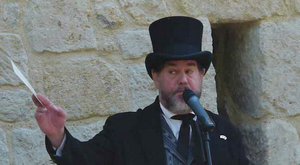 Karoly) De hunting is zuperb, here, Agoston!
Count) Rabbits, prairie hens, pheasant, passenger pigeons, deer, bear, elk, and
de timber wolf… yes… all have been brought down by this fine rifle.
Count) We
are almost to de top, Karoly! Ah! There it is!
Karoly) BEAUTIFUL!
Count)
Eureka! Eureka! This view is surely a masterpiece of nature… oh, how
magnificent! Nowhere in de world have I seen such an enchanting view. De river
and de gently sloping hills… leading down to de black soil of de unbroken
prairie… ideal for wheat and corn! De river reminds me of de noble Danube! Here…
Karoly… here is where I shall begin!
Narrator) The Count bought land…surveyed
and laid out a town he named Haraszthy. He started a hotel, planted wheat,
corn, barley, alfalfa, he had sheep, and cattle, and pigs, and goats….he
planted hops, and grapevines, and operated the first steamboat line on the
upper Mississippi and Wisconsin Rivers. IN 1841 The Count returned to Hungary
to bring back not only his wife and three children, but also his mother and
father.
Count) Mother, Father… America is de place for us! Dis vast country
with its freedoms is open to all. De American does not have to ask permission
to build railroads, canals, steamboats, machinery, factories and de like! He is
not hindered by two or three monopolies like here in Hungary. America! It is
truly de land of opportunity!
Narrator) But before his Wisconsin grape vines could
produce fruit news appeared about the Discovery of Gold in California… and
ambitious men all over the world found themselves making new plans. On December
30th The Wisconsin Democrat printed this article:
Newspaper man) The accounts
of gold found in California are most astonishing, and has set the whole country
in a fever for emigrating where gold is picked up like chips! Mining companies
forming daily! San Francisco booming with huge influx of capital from all over
the world!
Narrator) The Count, ever the visionary, gathered his family once
again.
Count) Family…We are moving to California! But we will not seek de gold…
it is for de commerce! And for de grapes! In San Diego, de weather is perfect…
de prospect of year long warmth fills me with joy!
Narrator) When spring
arrived the Haraszthy family joined a wagon train and began the journey west.
After 9 months of a seemingly endless journey the blue waters of the Pacific
Ocean were finally sighted from a mountain above San Diego. They had traveled
2,500 miles, and had many adventures along the way. The Count bought land in
what is now known as Mission Valley, and planted his first vineyard. He also
was elected the first Sheriff of San Diego County… much of his time was spent
explaining to the drunks that they had to stop shooting off their pistols into
the air.
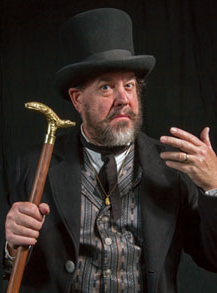 Haraszthy) Now, boys… you have got to ztop shooting in de street!
Somebody’s going to be hit… and then one of you is going to jail! Now I am de
Sheriff in dese here parts… and my jurisdiction extends from de Pacific Ocean
to de Colorado River… and from de Mexican border to de Southern Sierra. Now you
may gamble all you want…and you may yell at de moon… and go crazy for all that
I care. But you have GOT to stop shooting dos guns. Or I will throw you all in
de Hoosegow!
Haraszthy) Now, boys… you have got to ztop shooting in de street!
Somebody’s going to be hit… and then one of you is going to jail! Now I am de
Sheriff in dese here parts… and my jurisdiction extends from de Pacific Ocean
to de Colorado River… and from de Mexican border to de Southern Sierra. Now you
may gamble all you want…and you may yell at de moon… and go crazy for all that
I care. But you have GOT to stop shooting dos guns. Or I will throw you all in
de Hoosegow!
Narrator) In 1852 the Count was elected to the California State
Assembly. It was there he met General Vallejo… and tasted some of his wine.
General Vallejo will soon become an important person in our story. In the year
of 1852 he was a politician and gentleman farmer… but he had been the
Commandante General of Alta California… and had founded the City of Sonoma in
1834. After the Count saw the booming City of San Francisco… he decided that
San Diego was too sleepy and slow… San Francisco would be the place where REAL
commerce could take place. Once again… he spoke to his family.
Haraszthy)
Family! We are moving again! I have seen a city by a bay… with 35,000 people…
everything you can imagine is all happening at once! I have already purchased
land near de old Mission in San Francisco… and have started growing wheat,
corn, potatoes, oats and grapevines. Dese goods are sold at absurd prices… de
miners will pay anything... and they have de money! And flowers… I have planted
many, many rose bushes. I have named this nursery: Las Flores. We are moving to
San Francisco!
Narrator) The Count met fellow Hungarians in San Francisco… and
he soon became the Assayer of the US Mint in San Francisco. Always a quick
study, the Count had learned how to turn the raw silver ore into silver bars… a
laborious and complicated process. But his time at the Mint was marked with
controversy. The Count had become the subject of an official investigation.
Haraszthy) I will state… once and again for the Historical Record… that I am
innocent of all charges….and that de discrepancies in de accounts is the result
of inefficiencies in de smelting process… as demonstrated by this brick taken
from de top of de chimney at de mint. As you can see… it is covered with gold
dust!
Narrator) It wasn’t until 1861 that the Count was fully exonerated by a
Federal judge named McAllister.
Haraszthy) THANK YOU Judge McAllister!
Narrator) And now our story shifts to the very ground beneath your feet… the
Sonoma Valley which possesses an ideal climate and perfect soil for growing
grapes. The Count bought this property in 1857, and named it Buena Vista. He
made friends with many of his neighbors… one of those was General Mariano
Vallejo, the founder of the town of Sonoma. In our next scene we find the Count
and General Vallejo enjoying some of the General’s wine a few weeks after the
move from San Francisco.
General) You will find, Count Haraszthy, that your
enterprising spirit has finally found the correct place to exert its influence!
Count) I truly believe you are correct… I have found de perfect valley to grow
de finest grapes in de world. But I have not come to Sonoma just to make great
vine… I have come to build an industry! With scientific methods, California can
not only produce as noble a wine as any country on de face of the globe, but it
would export more dollars worth of wine, brandy, and raisins, than it does now
of gold!
Vallejo) Here, Here!
Count) Mariano… you have many vinifera vines…
European vines at Lachyrma Montis.
Vallejo) Most certainly, Agoston!
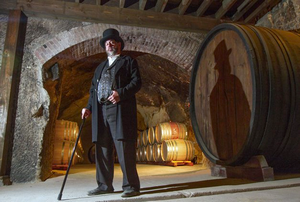 Count) As
do I… but we need to be scientific about this… we need more Vinifera varieties
from Europe. No man can fully comprehend yet what fine wines we will be able to
make, when we have ze proper assortments of ze different qualities of foreign
grapes. After all… if carrots will make a vegetable soup, it will be a poor
one, but take carrots, turnips, celery, parsley, cabbage, potatoes, and onions
und you will have a superior vegetable soup. So with grapes: take ze proper
variety of them and you will make a splendid wine.
Count) As
do I… but we need to be scientific about this… we need more Vinifera varieties
from Europe. No man can fully comprehend yet what fine wines we will be able to
make, when we have ze proper assortments of ze different qualities of foreign
grapes. After all… if carrots will make a vegetable soup, it will be a poor
one, but take carrots, turnips, celery, parsley, cabbage, potatoes, and onions
und you will have a superior vegetable soup. So with grapes: take ze proper
variety of them and you will make a splendid wine.
Vallejo) (Laughing and
raising his glass) Time for lunch!
Narrator) In 1861 the Count convinced the
California Legislature to make him an official commissioner… and he journeyed
to Europe to bring back European grapevines. Upon his return 7 months later he
had collected over 100,000 vine cuttings of 353 different varietals, but at the
beginning of the long American Civil War the Legislature had changed their mind
about paying for his expenses. In 1863 his Buena Vista Winery incorporated and
sold shares. It was the first modern agricultural corporation in California. Our
next scene takes place on May 1st, 1863. We see two gentleman friends, once
again enjoying wine and discussing the upcoming wedding of Attila and Arpad Haraszthy
to Jovita and Natalia Vallejo. It was to be the double wedding of the century!
General) Count Haraszthy… I raise this glass of fine Sonoma Valley wine to YOU…
in the last six years you have transformed this sleepy valley and brought
scientific winemaking to California!
Count) Thank you… General Vallejo. Coming
from you… this is a great honor!
General) My dear Count… Buena Vista is the
largest vineyard in the world… …you have dug wine caves, and built gravity fed
stone wineries next to them,… brought many European viticulture techniques to
California; including the new idea of planting grapevines closer together to
stress the grapes, thus reducing yield and improving grape quality… you have
been made the President of the California State Agricultural Society which you
founded… journeyed to Europe as an official Commissioner of the California
State Assembly… brought back all those Vinifera vines… many of which now reside
in my vineyards…
Count) (Laughing and gesturing with wine glass) My friend… my
friend… wet your whistle… you will most certainly overheat!
General) (Taking
glass and clinking with the Count) You stopped me as I was about to get to the
best part… the marriage of my daughters to your sons a month from today!
Count)
I agree with you… this is certainly the best part.
General) Never have two such
young men taken a valley by storm as your two sons have done! Count) Your
daughters are more than formidable, General.
General) In the battle of romance
they proved the better skirmishers… but in this contest there are only winners.
Count) I have laid in a large supply of Cliquot champagne for de wedding! As
you may know, Arpad studied wid de Widow Cliquot herself.
General) I also have
laid in a large supply from my San Francisco merchants. I expect great things
from Arpad… he is more than a good catch for Jovita.
Count) Both my sons are
vigorous and wellmeaning… I have no doubt that progeny will be generous for
both.
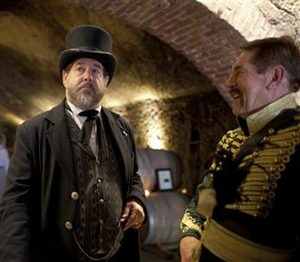 General) Any news… General… of the $12,000 still owed you by the State of
California to recompense your expenses for your journey to Europe?
General) Any news… General… of the $12,000 still owed you by the State of
California to recompense your expenses for your journey to Europe?
Count) Ahhh…
such sums matter little when discussing eternal love and devotion.
General) And
yet $12,000 is no small sum.
Count) I believe that the hope that the California
Assembly will revisit the matter may be accurately described as a political
non-starter.
General) Well… you did succeed in bringing to California so many
cuttings of fine European grape varieties… tell me… was Zinfandel among them?
Count) I predict, General… that someday Zinfandel will be regarded by many as
my gift to California… but I seem to have misplaced de papers proving this to
be the case.
General) We’ll let the historians wrestle with that one. One more
thing, my dear Agoston… I must congratulate you on the creation of the Buena
Vista Viticulture Society… with… I believe 6,000 shares offered at $100 a
piece… that puts incorporation at $600,000!
Count) I have a share in my pocket
for you… my friend… just a token suitable for framing.
General) Could you
reserve another 100 for me?
Count) Indeed Good SIR!
General) And now I suggest
we spend our time enjoying this 1855… it was a VERY good year!
Narrator) But
now… at the height of our Hero’s success… TRAGEDY! It had been lurking on the
edges of the Count’s life since 1860. It would someday be known as Phylloxera
Vasatrix: The Destroyer! At first, only a few vines turned brown, grew weak,
died. He pulled them up and planted new ones. By the middle 1860’s whole rows
of vines had turned yellow, and the grapes were tiny, with no flavor. The Count
would never know it was an extremely small aphid… an extraordinarily nasty bug
that killed vines by strangling the roots. Worst of all, the Count’s new
European techniques were blamed for this unknown vine disease.
Narrator) In 1867 Count
Agoston Haraszthy filed for bankruptcy and was removed as the President of the
Buena Vista Viticultural Society. And so the Count did what he had done many
times since 1840. He went someplace new. He went to Nicaragua to make rum. We
know much of his time in Nicaragua as he wrote letters back that were published
by the Alta California. This is one of them. (Haraszthy enters… he is wearing a
tropical outfit with pith helmet)
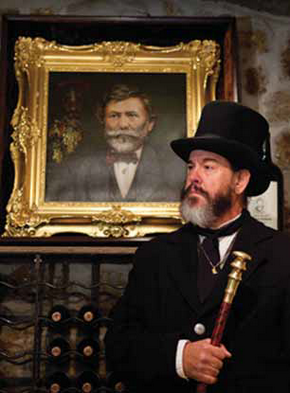 Narrator) Having arrived at a small coastal town named
San Juan del Sur, I soon found myself riding a mule up a gentle slope beset
with tropical greenery. All around me were monkeys, swinging themselves by the
hands and tails from limb to limb and tree to tree. We passed through cocoa and
coffee plantations; all around were trees full of mango, oranges, papayas and
cashews. We came upon an Indian town… where many industrious residents had
handmade wares for sale in the Plaza: colorful baskets, carved wooden dishes,
finely woven hammocks, and leather halters for horses and mules. All of a fine
quality that would fetch good prices in California.
Narrator) Having arrived at a small coastal town named
San Juan del Sur, I soon found myself riding a mule up a gentle slope beset
with tropical greenery. All around me were monkeys, swinging themselves by the
hands and tails from limb to limb and tree to tree. We passed through cocoa and
coffee plantations; all around were trees full of mango, oranges, papayas and
cashews. We came upon an Indian town… where many industrious residents had
handmade wares for sale in the Plaza: colorful baskets, carved wooden dishes,
finely woven hammocks, and leather halters for horses and mules. All of a fine
quality that would fetch good prices in California.
Narrator) This scheme
almost certainly would have worked… but on July 6, 1869, Count Agoston
Haraszthy set out by on mule back to explore their sugar-cane plantation. While
crossing a crocodile infested river by way of a large tree used as a natural
bridge, the Count slipped and fell into the river. His body was never found. Thus
endeth the life of our Hero: Count Agoston Haraszthy: The Father of California
Viticulture and Founder of this magnificent Buena Vista Winery.
Count) Yes! I
have returned! And what joy it is to breathe again the perfumed air of the
Sonoma Valley! And now that the cause of my woes… Phyloxera the Destroyer… has
been tamed through the use of American rootstock without diminishing the
flavors of my beloved European grapes! Buena Vista Winery is prospering beyond
my wildest dreams! My European Viticultural techniques are used by all! At the
most I had 400 acres under grapevines… now the total is 1,000 acres… and the
Ramal vineyards in the cool climate of Carneros produce extraordinary fruit for
their pinot noir, chardonnay, pinot gris, merlot and syrah wines.
Count) Thank you for
listening… please enjoy some very fine Buena Vista Wine inside the tasting room
to my left… and feel free to add a coin or two to the hat being passed now for
our humble players. (All players bow on unison)
Compiled by George Webber actor, Buena Vista Winery, Sonoma.
