


Iván András Bojár: Wine and Metropolis
Since 2005 the
movement “I love Budapest”, founded and directed by me, has been contributing
to the fact that Budapest and thus Hungary could have a better touristic and
investment assessment with the implementation of some relevant urban
development plans. After years of hard work, by 2010 the concept “Green
Budapest” was formulated by the civil organization. Analysing the identifying
marks and pillars of Budapest, we could concentrate on ten basic parameters.
The most significant of these is that duality is a basic feature in a
geographical and physical sense, and also, in the mind of foreigners visiting
the capital city. It is the duality of Buda and Pest, plain and hills, asphalt
jungle and green belt. It was obvious that the central conceptual and physical
axis of the Green Budapest development is the Danube from a lot of points of
view: the history of the city, infrastructure, lifestyle, development of
environmentally friendly urban management, not to mention the importance of
landscape. This holistic approach of complex development aimed to establish the
conditions and framework of normal and happy life. Following this track we
reached the question of gastronomy.
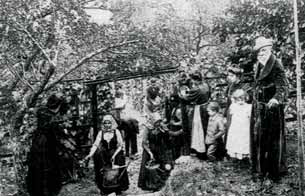 During the 150 years of Turkish Conquest
following the reign of King Matthias the features of Hungarian cuisine were
reshaped: it became richer, more colourful, but its previous character
disappeared. First we attempted to identify the typical vegetables and fruits
of the Middle Ages and the Renaissance through analysing the organic finds of
rubbish pits and wells excavated at the Buda Castle. We wanted to find the food
that served as the basis of the cuisine of the court at that time.
During the 150 years of Turkish Conquest
following the reign of King Matthias the features of Hungarian cuisine were
reshaped: it became richer, more colourful, but its previous character
disappeared. First we attempted to identify the typical vegetables and fruits
of the Middle Ages and the Renaissance through analysing the organic finds of
rubbish pits and wells excavated at the Buda Castle. We wanted to find the food
that served as the basis of the cuisine of the court at that time.
The question
of wine was also included in this research. During the Turkish Conquest Evlia
Celebi Turkish traveller recorded 12,000 vineyards on Buda region. However, in
the second half of the 19th century the vine-growing areas that had been
dominant on Buda hills from Roman times disappeared, due to the phylloxera
epidemic hitting Europe then. For more than a century there has been no
vine-growing in the capital, although wine and the associated holidays, events
and public occasions are inherent in social life. On the other hand, it is
important to take into account the economic and touristic benefits of wine
production. Vienna, for example, in contrast with the management of Budapest
120 years ago, re-planted the areas destroyed by the phylloxera, and today it
is the biggest wine-producing metropolis of the world.
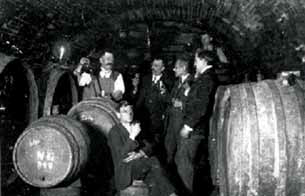 Wine is not merely a
product. It is also a culture expressing and strengthening local identity, the
form of life of a community, a festival. In our urban development plans we
wanted to favour these factors, thus affecting two projects. On the one hand, a
former civil initiative called “Buda Red” was revived resulting in new vine
plantation in the 12th district, in the former Jókai-villa, following my
example of planting vine on the western hillside of Buda Castle. On the other
hand, we intended to carry out a comprehensive programme for the annual
production of wine, aiming to reactivate the legendary inn-life in Tabán
district, which was expected to be very popular with tourists visiting Budapest
and with local people as well.
Wine is not merely a
product. It is also a culture expressing and strengthening local identity, the
form of life of a community, a festival. In our urban development plans we
wanted to favour these factors, thus affecting two projects. On the one hand, a
former civil initiative called “Buda Red” was revived resulting in new vine
plantation in the 12th district, in the former Jókai-villa, following my
example of planting vine on the western hillside of Buda Castle. On the other
hand, we intended to carry out a comprehensive programme for the annual
production of wine, aiming to reactivate the legendary inn-life in Tabán
district, which was expected to be very popular with tourists visiting Budapest
and with local people as well.
Since Tabán district was demolished in the
1920s- 30s, there is a green area with excellent location in the centre of the
city, presently underutilised, which regards its rich historical past,
memories, legends as a matter of pride. In 2010, not far from there, on the
western hillside of Buda Castle I promoted the establishment of the first,
one-hectare historical vineyard. Unfortunately the project was not successful due
to the improper care of cuttings and slips.
Tabán and Buda hills were the
typical production area of “Kadarka” wine for centuries. In the spirit of
authenticity and tradition we intended to re-plant vine, especially “Kadarka”
at a lot of places. I thought that with vineyards around old and new traditions
and holidays could be revived or formed. We could link festivals, parties,
social events to the harvest and other seasonal work. The most attractive
entertainment district in Vienna is still Grinzing. Budapest has been
disadvantaged in this aspect too since Tabán district was demolished in the
1930s. That was why we suggested that garden inns with vine arbours should be
formed under the trees outside certain cellars in Tabán. We were dreaming about
an entertainment district evoking the atmosphere of remote vineyards that could
revive the local traditions 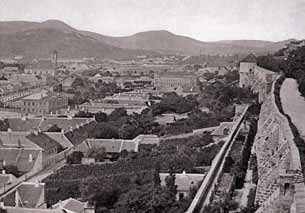 from the times before the demolition seventy years
ago. The specific cellars would have been named after the former pubs and inns
situated there, which today we can only know from the books by Krúdy or Márai
(The Three Hoemen, The Merry Vine-dresser, The Green Bunch or The Deep Cellar).
from the times before the demolition seventy years
ago. The specific cellars would have been named after the former pubs and inns
situated there, which today we can only know from the books by Krúdy or Márai
(The Three Hoemen, The Merry Vine-dresser, The Green Bunch or The Deep Cellar).
We could have introduced the atmosphere of a small town or a village into the
heart of a metropolis, creating a unique destination for the lovers of
gastronomic joys, establishing a primary presentation opportunity for the best
quality Hungarian wines. Resulting from its entertainment character, it would
have been reached by bikers or walkers rather than drivers, with easy access
for all city-dwellers. From April to October, on 22 weekends of the year each
wine-producing region could have introduced themselves with a wide range of
events: concerts, theatre plays, programmes for families and children, local
craftsmen, winegrowers and typical products of gastronomy.
All this was not an
isolated idea in the “Green Budapest” programme of the “I love Budapest”
movement. The revival of Buda wine production, the thematic development of
Tabán district are essential elements of a complex plan about the development
of the district, including other necessary, mutually beneficial elements, such
as covering the quays at the Danube bank, building more spas for the Buda Bath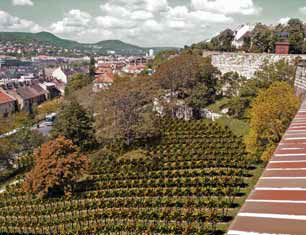 Quarter, planting vine on the southern hillsides of Castle Hill, joining the
so-called Castlegarden Bazaar and the inner-city of Pest (only 300 m in a
straight line from there) with a footbridge, a bridge for cyclists and
pedestrians (Green Bike Bridge).
Quarter, planting vine on the southern hillsides of Castle Hill, joining the
so-called Castlegarden Bazaar and the inner-city of Pest (only 300 m in a
straight line from there) with a footbridge, a bridge for cyclists and
pedestrians (Green Bike Bridge).
Unfortunately the project failed. The above mentioned planted vines did not take effect, they died. The Municipal Gardening Company even removed the stakes. The concept about Tabán district was disapproved due to the slanders and noisy protests of dog owners using the 30,000-sqm hillside of the inner city and to the cowardly and uncreative attitude of the management of the district. The footbridge will not be built on the Danube – for the time being. After the Castle-garden Bazaar is rebuilt and opened, and the government can see that due to its location the number of visitors is very low – then they will reconsider the idea. Spas will not be built. The covering of the quays, as an isolated idea, is a topic on the agenda; perhaps the mayor does not understand himself why. It is doubtful whether traditional wine production will return to Buda.
Iván András Bojár, Budapest
Presentation of Haraszthy200 Wine Conference;
5 October 2012, Tokaj.
