


Máté Lachegyi: Wine in Art
The proofs of
dressing vines and making wine can even be found in ancient times, and since
wine has had a significant role in almost each era of history, this theme
appears in a great number of depictions in visual arts. The first
representations of vine can be seen on cave paintings. Viticulture and
winedrinking were present in every culture of the ancient Middle East (in the
Sumerian state, in Egypt, in the Babylonian Empires), especially as a drink of
upper classes on festive and ceremonial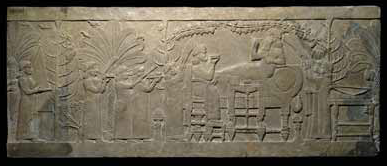 occasions, so they were often depicted
on frescos, small sculptures and pieces of handicrafts as well.
occasions, so they were often depicted
on frescos, small sculptures and pieces of handicrafts as well.
An example of
this is The Banquet Scene (also called “The Garden Party”), a wall
panel
relief, from the Nineveh palace of Neo-Assyrian ruler Ashurbanipal. In
fact the way people drank wine was not necessarily the same as today;
it was thinned
with water. Wines from other fruits and brandies were also known, and
beer was
also made then. In the ancient Greek civilizations mythology associated
with
winedrinking too: wine and inebriation caused by wine appears in the
cult of
Dionysus. We can often see the representations of the theme of wine and
its
god, Dionysus with his company, the maenads (bacchantes), Silenus and
the
satyrs on vase paintings, usually on pottery used for storing, mixing
and
pouring wine.
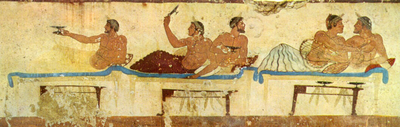 The form of drinking wine within a ritual framework, often
depicted in arts, was symposium. We can admire a unique representation of this
on a wall painting of a tomb in the Greek city of Paestum, South Italy (“The Tomb
of the Diver”).The Romans also adopted the Greeks’ wine culture and their god,
Liber, also called Bacchus, corresponded to Dionysus. However, in ancient
Greece or Rome grapes and wine did not only appear in a mythological or
cultural aspect. One of the best-known and most far-reaching myths of the
ancient times is about Parrhasius and Zeuxis, the two famous painters, who
compared their skills in
The form of drinking wine within a ritual framework, often
depicted in arts, was symposium. We can admire a unique representation of this
on a wall painting of a tomb in the Greek city of Paestum, South Italy (“The Tomb
of the Diver”).The Romans also adopted the Greeks’ wine culture and their god,
Liber, also called Bacchus, corresponded to Dionysus. However, in ancient
Greece or Rome grapes and wine did not only appear in a mythological or
cultural aspect. One of the best-known and most far-reaching myths of the
ancient times is about Parrhasius and Zeuxis, the two famous painters, who
compared their skills in 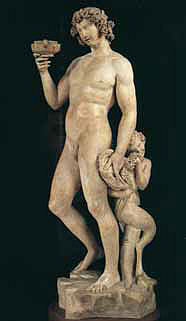 a contest. According to the myth, Zeuxis painted such
life-like grapes that birds flew down on the painting wanting to peck at them.
a contest. According to the myth, Zeuxis painted such
life-like grapes that birds flew down on the painting wanting to peck at them.
The influence of classical Greek-Roman mythology remained great in the Middle
Ages and particularly in the modern times. Mythological themes inspired
painters in the same way as in the ancient times. Artists from the Renaissance.
Baroque or later eras left masterpieces to us where grapes and wine appear in
the form of Bacchus or other mythological figures. Among the hundreds of
masterpieces we can mention the fascinating marble statue by Michelangelo
Buonarotti, “Bacchus”. On the other hand, apart from classical, pagan mythology
grapes and wine play a central part in another culture which has been effective
and alive even today: Christianity.
This religion arrived in a world where wine
had had a significant role in both pagan and Jewish culture. The Old Testament
often tells us about grapes and wine – Noah’s drunkenness, the sacrifice of
Melchizedek, Loth and his daughters etc. –, both in a positive and negative
aspect. Since Jesus Christ bequeathed His own body and blood to us under the forms
of bread and wine at the Last Supper with his disciples, vine as a Eucharistic
symbol appears on the different liturgical objects, 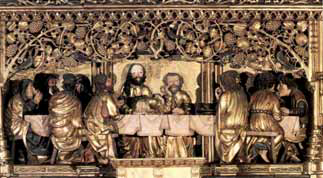 ornaments of churches and
works of art with Eucharistic theme. Thus, besides classical mythology, grapes
and wine have the widest range of iconography in Christianity. Among the
countless works one outstanding example is the Last Supper scene from Master
Paul of Levoča on the high altar of St. James church in Levoča, carved in wood
and decorated with gold (the Kingdom of Hungary, today Slovakia).
ornaments of churches and
works of art with Eucharistic theme. Thus, besides classical mythology, grapes
and wine have the widest range of iconography in Christianity. Among the
countless works one outstanding example is the Last Supper scene from Master
Paul of Levoča on the high altar of St. James church in Levoča, carved in wood
and decorated with gold (the Kingdom of Hungary, today Slovakia).
We can also
find representations of grapes and wine on worldly pictures. In medieval
secular art the works of viticulture or vintage often appear, in particular on
calendar-like depictions. Sometimes we can see them on paintings about feasts –
one of the most famous examples of it is the Norman banquet on the Bayeux
tapestry. As an independent subject, everyday scenes appear on the so-called
genre pictures in the Renaissance, together with still lifes. On the former
paintings the theme of wine occurs at feasts, vintage scenes and scenes with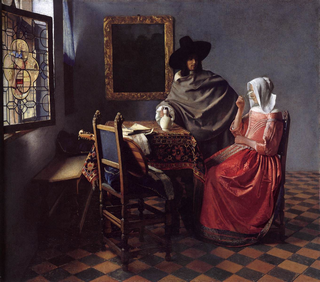 a
moral content (hard drinking, frivolous lifestyle).
a
moral content (hard drinking, frivolous lifestyle).
Wine can refer to facile
morals as a symbol on pictures with an apparently harmless theme: in the
Baroque era, especially with Dutch, Flemish and German artists, it was typical
to depict a man and a woman talking in a room, seemingly keeping the rules of
etiquette, but the wine glasses and other symbolic objects, or the pictures
hanging from the wall often refer to fornication or adultery. A typical example
of this is Jan Vermeer’s painting, “The Glass of Wine”, which definitely
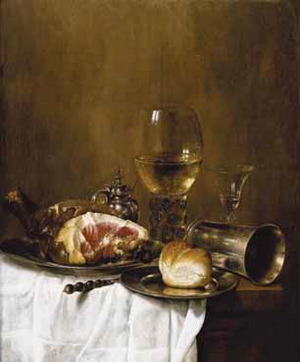
implies this hidden immoral behaviour for the contemporary beholder. Still
lifes were at the height in the Baroque, they flourished in Flemish art – here
painters, inspired by the requirements of wealthy civil societies, could create
such realistic and impressive techniques to paint the different textures,
materials, living and lifeless objects that they seem amazing even today. In
these paintings we cannot only admire the various fruits, objects,
specialities, but also the glass and metal works of the time – the wine glasses
and cups have the most varied forms and ornaments. Here we have to mention
handicrafts too that have been decorating and designing pieces of everyday use
 connected to wine since the ancient times.
Still lifes can have a moral message
at times: wine can refer to the Eucharist, but to drunkenness too. In addition,
wine is a regular element of the socalled vanitas still lifes, which draw our
attention to the transitory character of life by means of symbols of vain and
sinful acts. In one of the first fruit pieces, Caravaggio’s Basket of Fruit,
besides the cluster of grapes and other fruits some putrescent grapes and dry
leaves remind us of this transitory character in this moral aspect, but at the
same time in another sense: they emphasise the ability of the painter and the
painting that they can immortalize ephemeral, transitory things as well. A
particular style of painting genres is the so-called bodegón, i.e. a scene in
the kitchen or at the dining table, where still-life elements often mix with
people doing their everyday tasks – here we can observe wine and wine-drinking.
Naturally the artistic depiction of the theme of wine did not end in the
19th–20th centuries. Although styles and genres have become completely loose
since the era of the Impressionism, grapes and wine often appear on still
lifes, inn or party scenes, or even on portraits. Earlier, in the Renaissance
some portrait 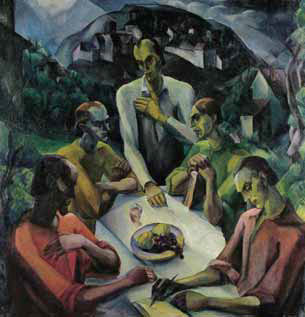 models were represented with a wine glass. From the Impressionism
the representation of winedrinking has got, if any, very little moral
character; in most cases the artists only seizes the atmosphere of it, or
paints the vintage and the vineyards, which can again have a moral nature with
its wish for peasant life in the countryside. Nevertheless it has been a
popular theme in secular art as well, both in more or less realistic and in
completely abstract depictions. Moreover, not as a novelty, design is also
related to wine in traditional craftsmanship (making wine vessels, bottles,
glasses) and in the field of labels, posters and advertisements.
models were represented with a wine glass. From the Impressionism
the representation of winedrinking has got, if any, very little moral
character; in most cases the artists only seizes the atmosphere of it, or
paints the vintage and the vineyards, which can again have a moral nature with
its wish for peasant life in the countryside. Nevertheless it has been a
popular theme in secular art as well, both in more or less realistic and in
completely abstract depictions. Moreover, not as a novelty, design is also
related to wine in traditional craftsmanship (making wine vessels, bottles,
glasses) and in the field of labels, posters and advertisements.
A unique or, rather, experimental interpretation of the relationship between wine and art is János Szász Saxon’s series, made for the “Red & White” exhibition at the Haraszthy 200 Festival. In it he made thick distillation of different wines and painted pictures on handmade paper with it in his own abstract geometrical style, inspired by the taste of the given wine.
Máté Lachegyi undergraduate art historian, Vác
Presentation of Haraszthy200 Wine Conference;
5 October 2012, Tokaj.
