


János Szász Saxon: Painting with wine and art
The theme of wine has accompanied the art of the centuries from
ancient times, through medieval Christian art till today. Artists of
different periods have had different techniques and styles to depict
scenes, legends, sacred events related to wine. Painting with wine is
present in contemporary art. Some people have attempted to use wine as
a matter, as paint, particularly in creating traditional descriptive,
water colour-like paintings. They achieved the desired surface and
visual effect by manipulating the basic material, usually by mixing the
wine with other painting matters, thus making landscapes, portraits and
still lifes.
When I was requested to make my own works of art from a selection of
wines containing six different Hungarian kinds, I was inspired to start
working. First of all, 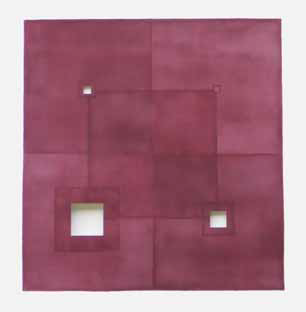 geometric
style, which I also use in my art, allows me to separate from
descriptive art completely. The world without objects in art created by
Kazimir Malevich has always been an example to follow for me. The
essence of art is the pure feeling, that is, the primacy of pure,
trimmed sense. My artistic method is poly-dimensional geometric plane
painting, whose system of forms was completely suitable for using the
basic material made from the condensed wine. In this way wine was not
only a theme, not only a means, but an objective in the focus of
attention.
geometric
style, which I also use in my art, allows me to separate from
descriptive art completely. The world without objects in art created by
Kazimir Malevich has always been an example to follow for me. The
essence of art is the pure feeling, that is, the primacy of pure,
trimmed sense. My artistic method is poly-dimensional geometric plane
painting, whose system of forms was completely suitable for using the
basic material made from the condensed wine. In this way wine was not
only a theme, not only a means, but an objective in the focus of
attention.
The fragrance of the wine paintings, their shades between white and
deep purple, the way the paint coats the surface of the fibres in the
paper merging into them, the showthrough effects due to the number of
layers painted on one surface, brilliance resulting from
crystallization of sugar and dry matters, the blotchy effects coming
from the unevenness of laid paper or strokes of the brush all possess a
kind of transcendental sensitivity, and raise the pure sense of wine as
paint in the viewer.
Before starting the Work, I felt inward and outward willingness to
taste and test three kinds of white and three kinds of red wines for
days so that I could choose the geometric forms which would suit the
character of the wines best. The sharpest, the most vibrant acidic dry
wines were matched with the triangular system of forms. Naturally, the
sweet white wine and the gentlest and least acidic “round” red were
given the poly-dimensional circles. Finally, wines full of hidden
tension, yet stable and calm, received the polygonal shapes: square for
a red wine and the honeycomb-like hexagon for the semi-sweet white
wine.
My friend, László Bálint sommelier chose the wines very carefully so
that very different kinds would be on the palette meeting the possible
aesthetic requirements.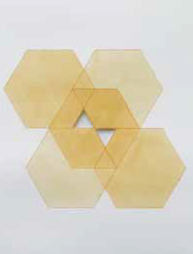 So the condensed wine suitable for painting was obtained by gentle
distillation from a sweet white (Fortissimo), a semi-dry white (Zengő)
and a dry white (Furmint), a quality dry table red (Tinta) and blending
different kinds of red wines in various proportions (Overdose,
Imperium). During distillation I had to take care of the temperature so
that it would not exceed 50 °Celsius, which could start unfavourable
decomposition and oxidation processes that would destroy the living
structure and the natural colouring matter of wine. I could obtain the
most suitable paint by 10% concentration. A higher percentage resulted
in a thick material which was too sticky and difficult to work with and
would never dry.
So the condensed wine suitable for painting was obtained by gentle
distillation from a sweet white (Fortissimo), a semi-dry white (Zengő)
and a dry white (Furmint), a quality dry table red (Tinta) and blending
different kinds of red wines in various proportions (Overdose,
Imperium). During distillation I had to take care of the temperature so
that it would not exceed 50 °Celsius, which could start unfavourable
decomposition and oxidation processes that would destroy the living
structure and the natural colouring matter of wine. I could obtain the
most suitable paint by 10% concentration. A higher percentage resulted
in a thick material which was too sticky and difficult to work with and
would never dry.
Having a looser, yet more uneven fibre structure, laid paper would
absorb the remaining moisture more easily, so the layers dried more
quickly. I could apply the condensed wine in several layers. Certain
dry, more acidic wines (Furmint), when applied several times, made the
paper surface structure even looser. I found water colour paper more
resistant to these unfavourable effects, but contrary to their names
they could not absorb the remaining moisture easily. They could take in
the sweet (Fortissimo) or semi-sweet (Zengő) white wines in fewer
layers, and owing to the higher sugar content it will take a long time
for the surface to dry up, maybe until the closing of the exhibition!
The wine paintings were made from the wines of the following six Hungarian wineries: Szőke Mátyás Pincészet, Mátra; Tokaj Kereskedőház, Tokaj; EvoWine Borászat, Eger; Gere Attila Pincészete, Villány; Bock Pince, Villány; Gróf Degenfeld Borászat, Tokaj.
János Szász Saxon artist, Szokolya
Presentation of Haraszthy200 Wine Conference;
5 October 2012, Tokaj.
