


Bálint Szombathy's opening speech, B55 Gallery
I must begin by saying that
I have come from that part of today’s Serbia that we Hungarians still call the
“Southland”, retaining its old name used in the Kingdom of Hungary. This is why
I felt deeply touched when Zsuzsa Dárdai, who also traces her roots to that
region, turned to me, seeking contacts in the town of Futak (Futog in Serbian),
the former border fortress situated on the left bank of the Danube. I learned
from her that Agoston Haraszthy had been born there in 1812: the man who later
became a sheriff in America, and moreover, who laid the foundations of the
famous California wine industry.
Unfortunately, Haraszthy’s name has not been
preserved in the collective memory of Hungarians living in Vojvodina, just as
the town of Futak is not the same as it was two hundred years ago. Its
inhabitants are not interested in the brave Hungarian guy who set out on his
way from there to cross the ocean and start a new life in the Wild West, in the
middle of nowhere, or the sacred land of the Indians. Nor are they affected by
the pioneering spirit of this man who made an individual achievement comparable
to that of inventor Nikola Tesla, who came from even further south of the
Danube. He also sowed the seeds of a new culture where nothing similar had
existed before.
Going further than simply discovering her family roots, Zsuzsa
Dárdai began thinking through the potentials of Ágoston Haraszthy’s history. As
someone living in an 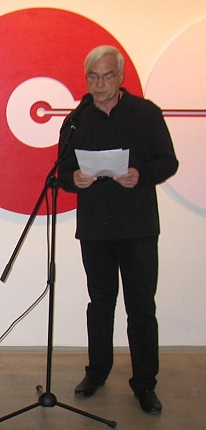 artistic milieu, it was only natural for her to proceed in
the direction of the visual arts. An artist and arts organizer herself, along
with her husband, artist János Saxon Szász, they have direct experience of the
magic of creation, including the mythical inspiration of wine. Regarding this
mythology, I think it is no longer necessary to refer to our great classical,
wine-loving poets and writers, as we can also find relevant clues and authentic
links in contemporary art, adding to the timeless glory of the divine nectar:
wine.
artistic milieu, it was only natural for her to proceed in
the direction of the visual arts. An artist and arts organizer herself, along
with her husband, artist János Saxon Szász, they have direct experience of the
magic of creation, including the mythical inspiration of wine. Regarding this
mythology, I think it is no longer necessary to refer to our great classical,
wine-loving poets and writers, as we can also find relevant clues and authentic
links in contemporary art, adding to the timeless glory of the divine nectar:
wine.
I would only like to linger on one of the many possible examples, for it
helps us connect to the intellectual and spiritual aura of this exhibit. From
among contemporary visual artists, I have witnessed no higher love and respect
for wine than in the work and life of the Austrian Hermann Nitsch. One might
say that all his infamous mystery plays and dramatic orgies are based on wine,
elevating people from quotidian life to a jubilant intoxication of being.
Obviously, it is not drunkenness that we speak of here, but illumination of the
highest degree that an artist may attain in the intoxicated state of mind
pertaining to creation. Wine is the divine substance by which one may attain a
state whereby mystic entrancement can occur. Nitsch spoke about how he had
discovered the enchanting wine region in the vicinity of Vienna, where he felt
as if his all being was becoming transubstantiated, where he found an ideal
frame for life, the realm of joyful ecstasy. In his text from 1977, Ready for
Intoxication, he wrote the following about their sessions of joint
winepartaking: “There was something touching about these common experiences of
seeking intoxication. People forgot about their petty-minded egos, and got
closer to one another. Through intoxication, the petty bourgeois purchased for
themselves a sense of amiable grandeur, a gentle way to liberation from the
confines of quotidian reality. They entered into relationships with other
people and perceived themselves in the other, becoming submerged in the
collective layer beyond themselves. They were touched by humanity, the human
species pointing beyond the individual. Although many of them had never met
before, all of a sudden, they were on good terms with one another. A sense of
fraternal benevolence, beautiful commonality of intoxication and happiness
dissipated over them all. In intoxicated life, the metaphysical dimension of
life becomes perceptible. You attempt to overcome death. You feel as if your
life was eternal. Those who are intoxicated sing.”
This is one of the most
beautiful and succinct descriptions of the magic of wine, the magic that gave
occasion not only to this exhibition, but also to a large-scale festival
joining different nations, from Budapest, Hungary, to Sonoma, USA, and from Sonoma
back to Tokaj. The two masterminds behind the event invited outstanding
representatives of mostly geometric art, ten American and ten Hungarian
artists, to join in the exhibition entitled Red & White. In the vocabulary
of geometric abstraction, the experiential world of the internal self and its
visions are articulated in its essence, rather than being depicted in a
descriptive manner. Therefore, this language lends itself to reflections on
sensations, including the “intoxication of being” engendered by wine. In
addition to genuinely expressing sensations, it also conveys the realm of
colors belonging to wine, with all its tinges, glimmers, swirls, vibrations and
impression of depth. We are confronted in the paintings with pure sensitivity:
the notion of the transcendental that only the greatest of artists have been
able to approach and express, such as Kazimir Malevich, the Suprematist painter
who soared to ethereal heights and believed to find the closeness of God
through his reductionist method of colors and forms.
Viewing the paintings and
other artworks presented here, you can perceive the spiritual commonality of
the twenty artists. These artists have become close to one another. What more
does one need? Wine has accomplished its sacred mission.
Bálint Szombathy
Beauty Expert
Opening remarks at the exhibition, red & white, organized under the auspices of the Haraszthy200 Festival, B55 Contemporary Art Gallery, Budapest, October 4, 2012.
